Reading Members of OPC UA Structured Variables
An OPC UA structured variable holds a complex data structure made up of named members. When a display, expression, or client needs only one value from the structure, use the member() modifier to read that member as a separate point. Some structures define optional members that the server includes only in some cases. Use the memberexists() modifier to check whether such a member is present before you rely on its value.
Both modifiers use the same syntax, where <complexPointName> is the name of a point whose value is a structure and <memberName> is the name of a member of that structure:
-
member() returns the value of the member, or a value with Bad quality if the member does not exist. To read a member of a nested structure, continue the path with dots, for example
member(<complexPointName>).BuildInfo.SoftwareVersion. -
memberexists() returns a read-only Boolean value that is true when the member exists and false when it does not.
The following procedure shows both modifiers in a GraphWorX display. Before you begin, create an OPC UA connection to a server that exposes structured variables, and select Fetch Complex Type Information in the connection settings. If this setting is cleared, GENESIS receives the structure as an undecoded byte array and the modifiers cannot resolve its members.
The examples use a connection named UaCpp to the Unified Automation C++ demo server, which exposes the structure StructureWithOptionalFields with the member MandatoryInt32. Substitute the point and member names from your own server.
To read a member of a structured variable and check whether it exists:
-
Open GraphWorX in the configuration mode (default).
-
On the Dynamics ribbon, select Process Point, and then add the process point element to the canvas.
-
In the right panel on the Dynamics tab, select DataSource and click
 to open Data Browser.
 -
Expand Data Connectivity > OPC UA > UaCpp, select the structured variable, and then click OK. The point name is added to the DataSource property field.
-
In the DataSource field, enclose the point name in member() and append the name of the member to read. For example:
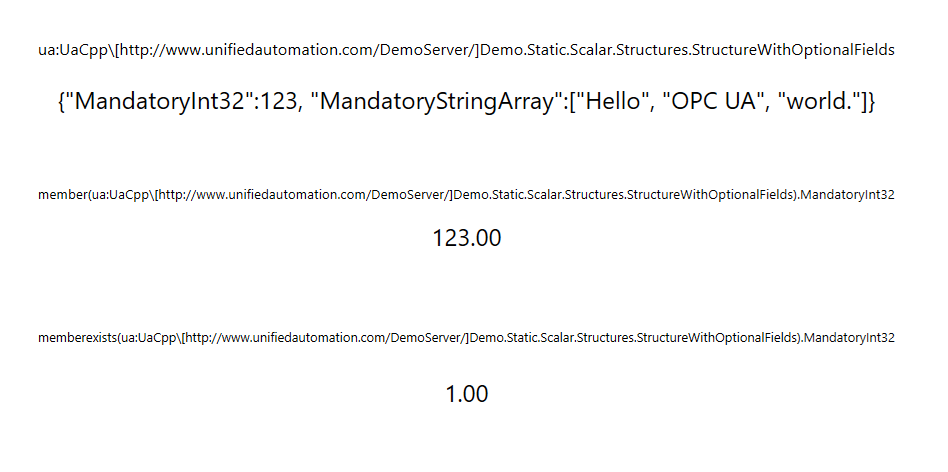
member(ua:UaCpp[http://www.unifiedautomation.com/DemoServer/]Demo.Static.Scalar.Structures.StructureWithOptionalFields).MandatoryInt32 -
Add a second process point, repeat steps 3 and 4, and then enclose the point name in memberexists() with the same member name. For example:
memberexists(ua:UaCpp[http://www.unifiedautomation.com/DemoServer/]Demo.Static.Scalar.Structures.StructureWithOptionalFields).MandatoryInt32To show a member value only when the server includes it, use the memberexists() point as the data source of a Hide dynamic on the object that displays the value.
-
Use the options on the upper right of the GraphWorX screen to switch to the runtime mode
 or to open the display in a web browser
  . The first process point displays the value of MandatoryInt32, or Bad quality if the server omits the member. The second process point displays 1 if MandatoryInt32 exists or 0 if it does not.