Alarm Server Architecture
The internal architecture of the Alarm Server is designed to overcome the limitations of its predecessor, AlarmWorX64, by leveraging a modern and modular approach. Here are some the main architectural components:
Topology
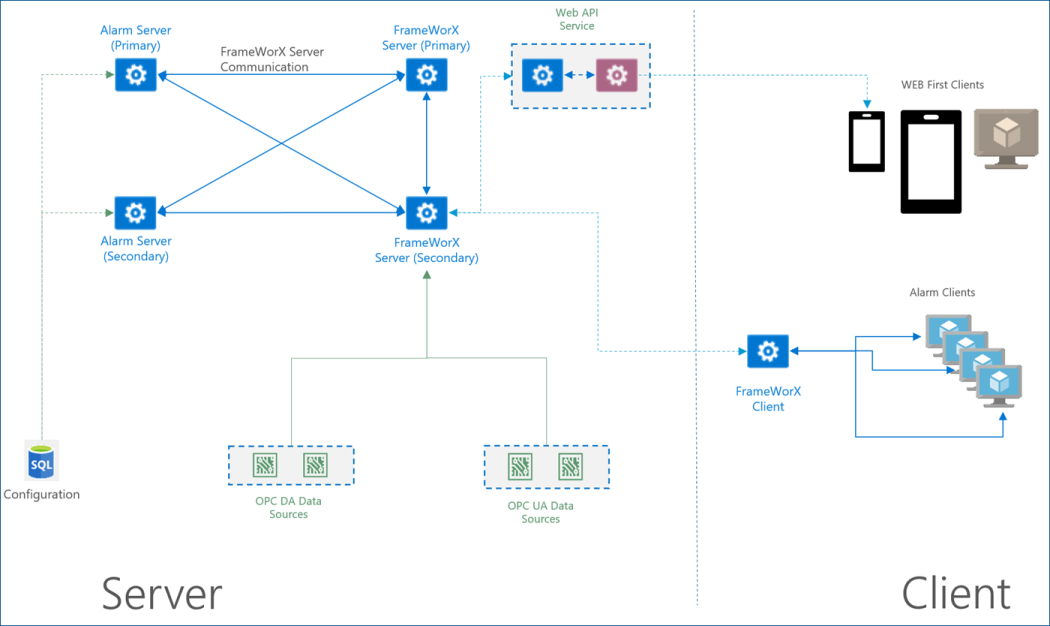
Key Features
|
Feature |
Description |
|---|---|
|
Integration with FrameWorX |
The Alarm Server is integrated with FrameWorX communication infrastructure. This integration allows for improved real-time data handling, historical data processing, and communication with third-party systems. It uses the FrameWorX interface to expose the alarm data and manage the communication between various system components. |
|
Modular Alarm Types and Sources |
|
|
Asynchronous Processing |
The system supports asynchronous processing, meaning that alarms are processed in parallel, avoiding delays in alarm handling due to slower or long-running operations. |
|
Redundancy |
|
|
Storage of Alarm States |
Optionally, alarm states are stored persistently, ensuring that alarms retain their statuses (e.g., acknowledged, active) even after a restart or failover. This is crucial for maintaining operational consistency in non-redundant systems. |
|
Client Access and Subscriptions |
Alarm data is available to clients via FrameWorX Server’s point manager, allowing subscriptions to real-time alarm events. Clients can subscribe to specific alarms or entire areas, ensuring flexibility in how alarms are monitored. Clients can access alarm data in a hierarchical structure, with alarms being organized into "Areas," which are logical groupings of alarm sources. |
|
Customization and Flexibility |
The Alarm Server architecture allows for extensive customization of alarm conditions, including custom fields, triggers, and evaluation expressions. The use of hierarchical structures and areas provides a logical organization for managing large numbers of alarms across different parts of a process. |
|
Alarm States and ISA 18.2 State Machine |
The server supports the ISA 18.2 state machine, which defines a standard alarm lifecycle, including states like Normal, Active, Acknowledged, and Shelved. This ensures that alarm transitions are handled in a standardized and predictable manner. |